Hello everyone!
This is Delphine’s first video about the object Pronouns in French.
Delphine is a French teacher at the language school alpha.b.
Hello I am Delphine, I am a teacher at the school alpha.b in Nice.
You can also find us on the platform e-alphab.com
In the lesson today we will talk about object pronouns.
There are two types of object pronouns:
- Direct object pronouns
- Indirect object pronouns
Direct Object Pronouns
Their function is to replace a ‘thing’ with the question “What?” or a person with the question “Who?”.
Looking at some concrete examples:
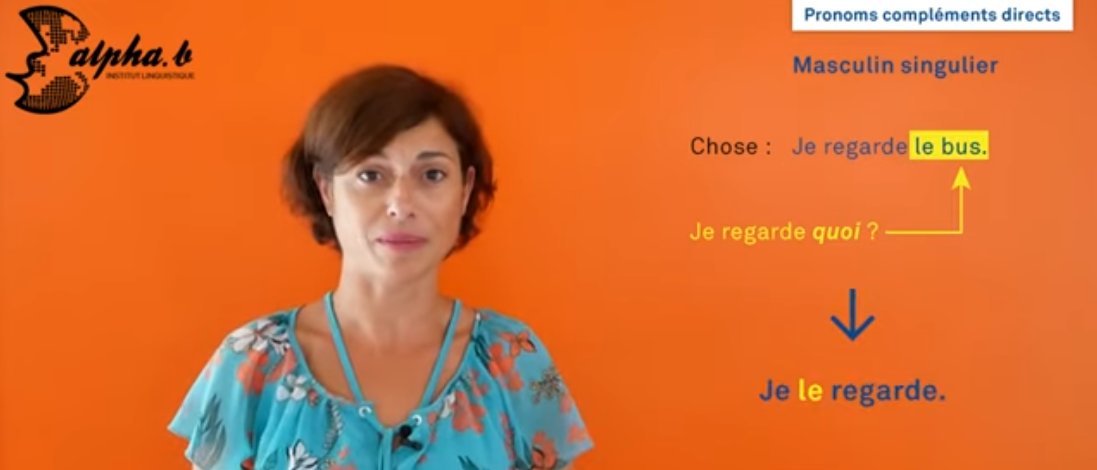
In the masculine singular:
“Je regarde le bus.” (I watch the bus)
“Je regarde quoi ?” (What do I watch?)
“Le bus.” (The bus)
“Je le regarde.” (I watch it)
Another example with a person:
“Je regarde Paul.” (I watch Paul)
“Je regarde qui ?” (Who do I watch?)
“Paul.” (Paul)
“Je le regarde.” (I watch him)
Another solid example, the feminine singular:
“Je regarde la television.” (I watch the television)
“Je regarde quoi ?” (What do I watch?)
“La télévision.” (The television)
“Je la regarde.” (I watch it)
For a person it is the same thing.
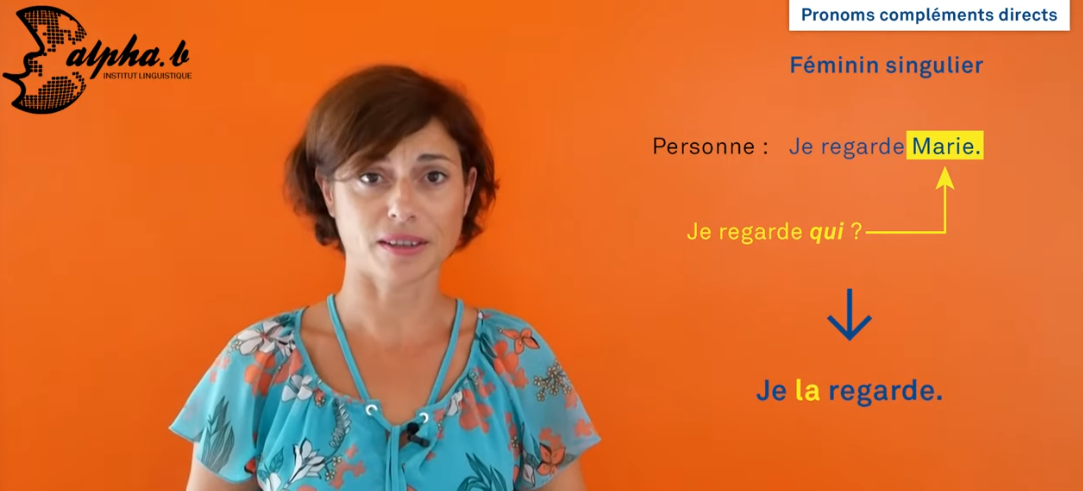
“Je regarde Marie.” (I watch Marie)
“Je regarde qui ?” (Who do I watch?)
“Marie ?” (Marie)
“Je la regarde.” (I watch her)
Looking at a plural example:
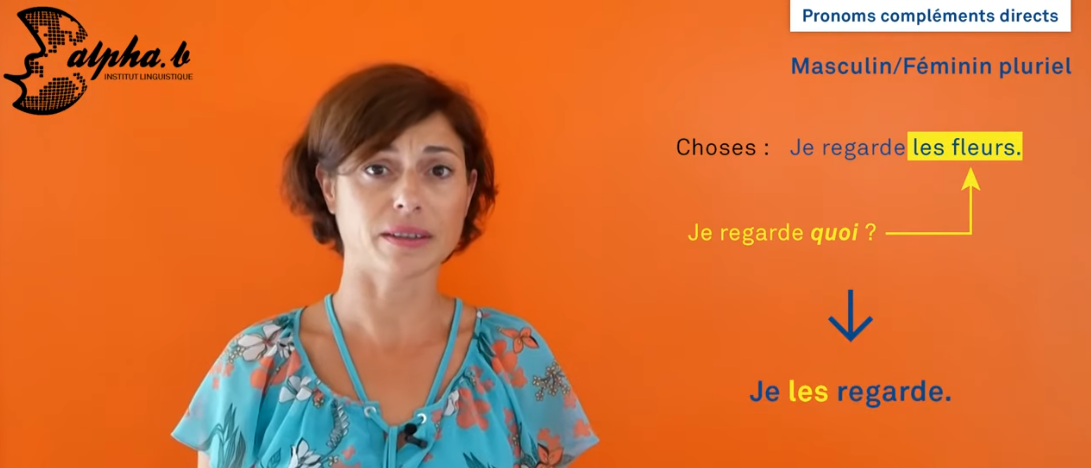
“Je regarde les fleurs.” (I look at the flowers)
“Je regarde quoi ?” (What do I look at?)
“Les fleurs.” (The flowers)
“Je les regarde.” (I look at them)
“Je regarde les enfants jouer.” (I watch the children play)
“Je regarde qui ?” (Who do I watch?)
“Les enfants.” (The children)
“Je les regarde.” (I watch them)
The direct pronoun varies with the person.
There are, however, variations in front of verbs starting with a vowel:
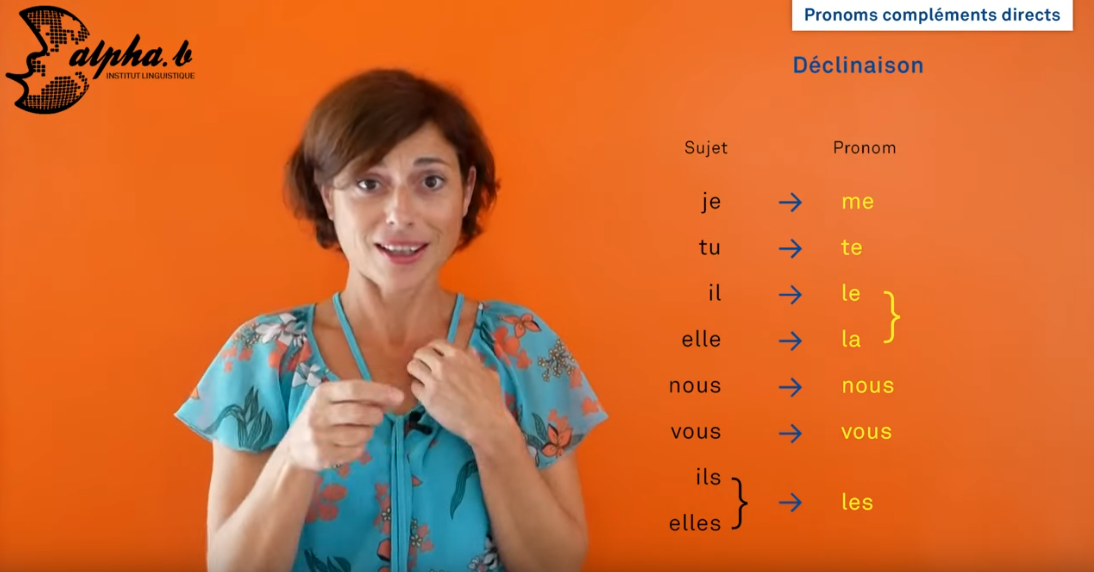
ME –> M’
TE –> T’
LE / LA –> L’
Some solid examples :
“Il m’écoute” (He listens to me)
“Il t’adore” (He loves her)
“Il t’invite à dîner.” (He invites you to dinner)
The negation of object pronouns
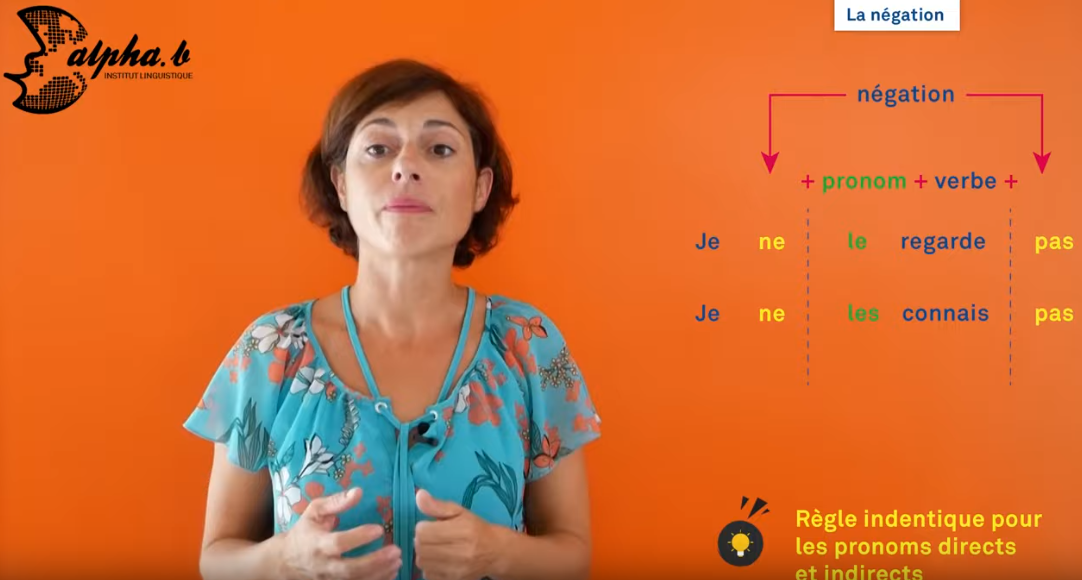
The negation goes before the pronoun + verb group.
“Je ne le regarde pas.” (I don’t watch it)
“Je ne les connais pas” (I dont know them)
We will move onto the exceptions.
When using the verbs “aimer” and “connaître”, you do not use the pronoun to speak about something or to respond to a question.
For example if I ask the question:
“Vous aimez le fromage?” (Do you like cheese?)
You would not say: “Oui je l’aime”
But you would say: “Oui j’aime ça ou non je n’aime pas ça” (Yes, I like it or no, I don’t like it)
Another example:
“Tu connais le Côte de Provence ?” (Do you know the Provence Coast?)
“Oui je connais” (Yes I know it)
“Non je ne connais pas.” (No, I don’t know it)
Indirect Object Pronouns:
They replace objects introduced by the preposition: “à”
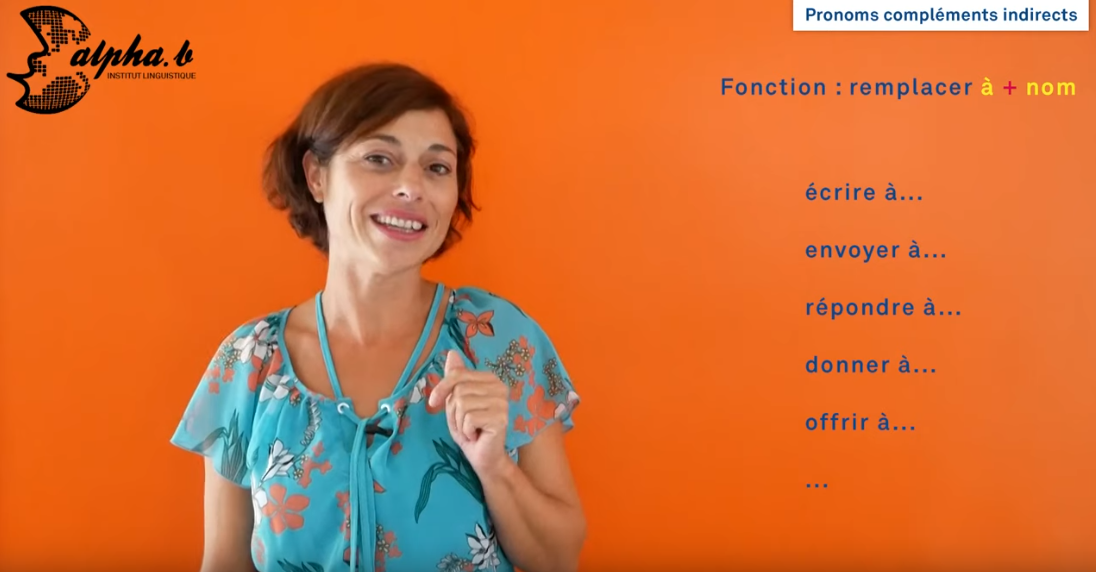
They can replace people but not ‘things’.
Many verbs of communication, of contact are used with the preposition “à”.
The pronoun “lui” replaces a masculine noun or a feminine noun.
A solid example with a masculine name:
“Je téléphone à Pierre.” (I phone Pierre)
“Je téléphone à qui ?” (Who do I phone?)
“À Pierre.” (Pierre)
“Je lui téléphone.” (I phone him)
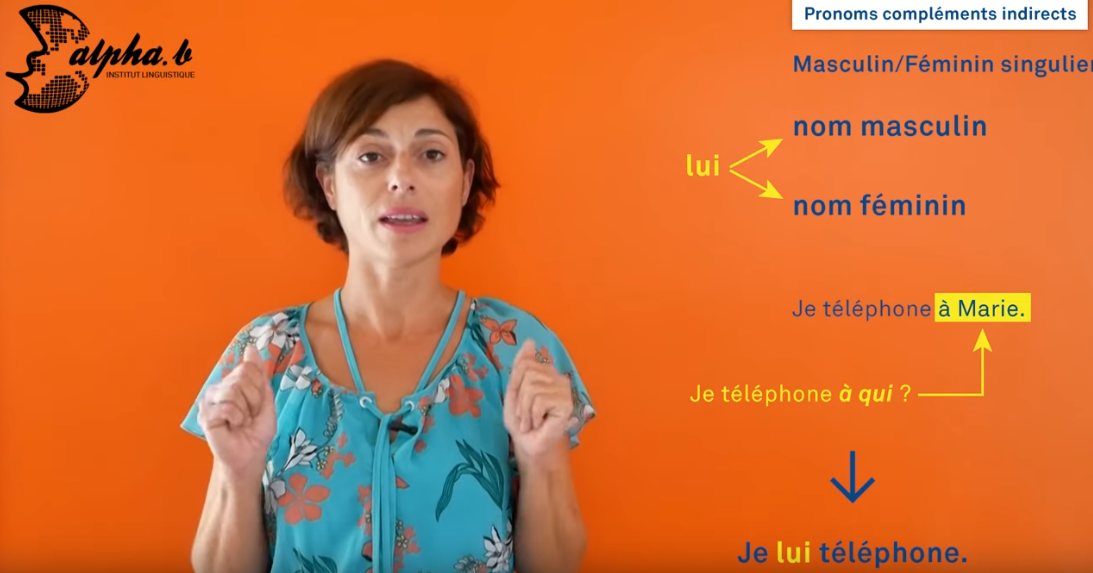
Another example with a feminine name:
“Je téléphone à Marie.” (I phone Marie)
“Je téléphone à qui ?” (Who do I phone?)
“À Marie.” (Marie)
“Je lui téléphone.” (I phone her)
We will now concentrate on the plural.
Whether it is masculine or feminine we use “leur”.
“Pierre parle à ses soeurs.” (Pierre talks to his sisters)
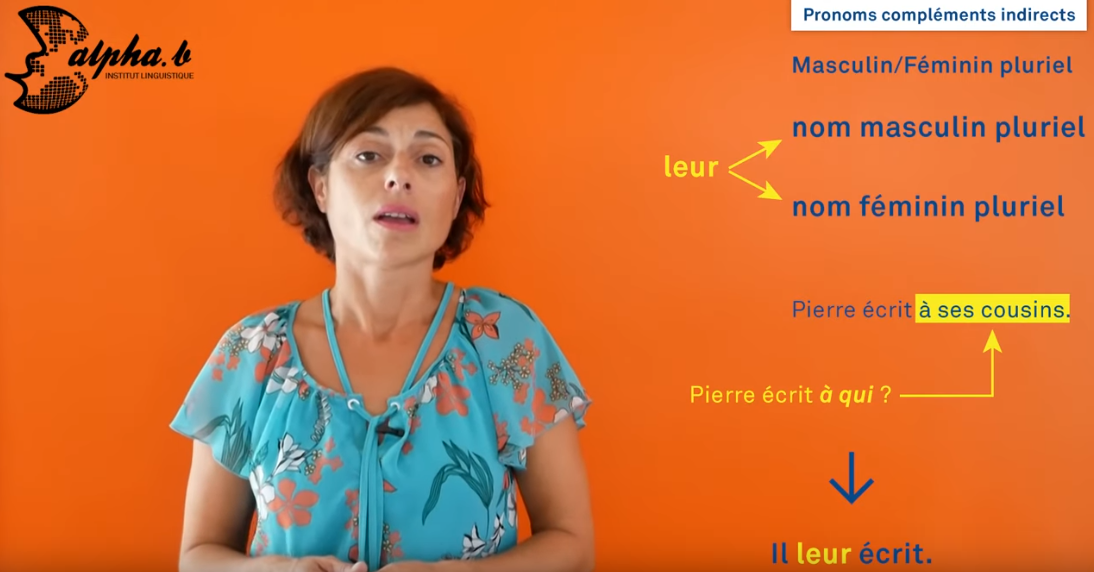
“Il parle à qui ?” (Who does he talk to?)
“À ses soeurs.” (To his sisters)
“Il leur parle.” (He talks to them)
Here is the construction of indirect object pronouns:
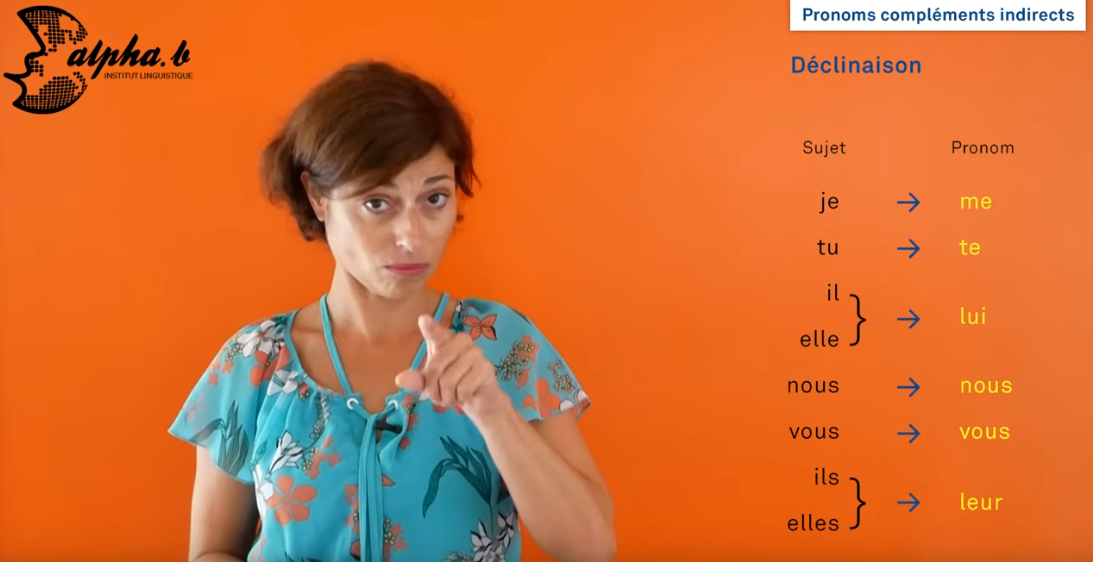
You cannot say “Paul téléphone à moi”, but “Paul me téléphone” (Paul phones me).
That is all for our new lesson on direct and indirect object pronouns.
We hope to see you again soon on screen on our YouTube channel or directly at the school alpha.b.